
Returning to Ballintoy Elephant: A Summer Sunset
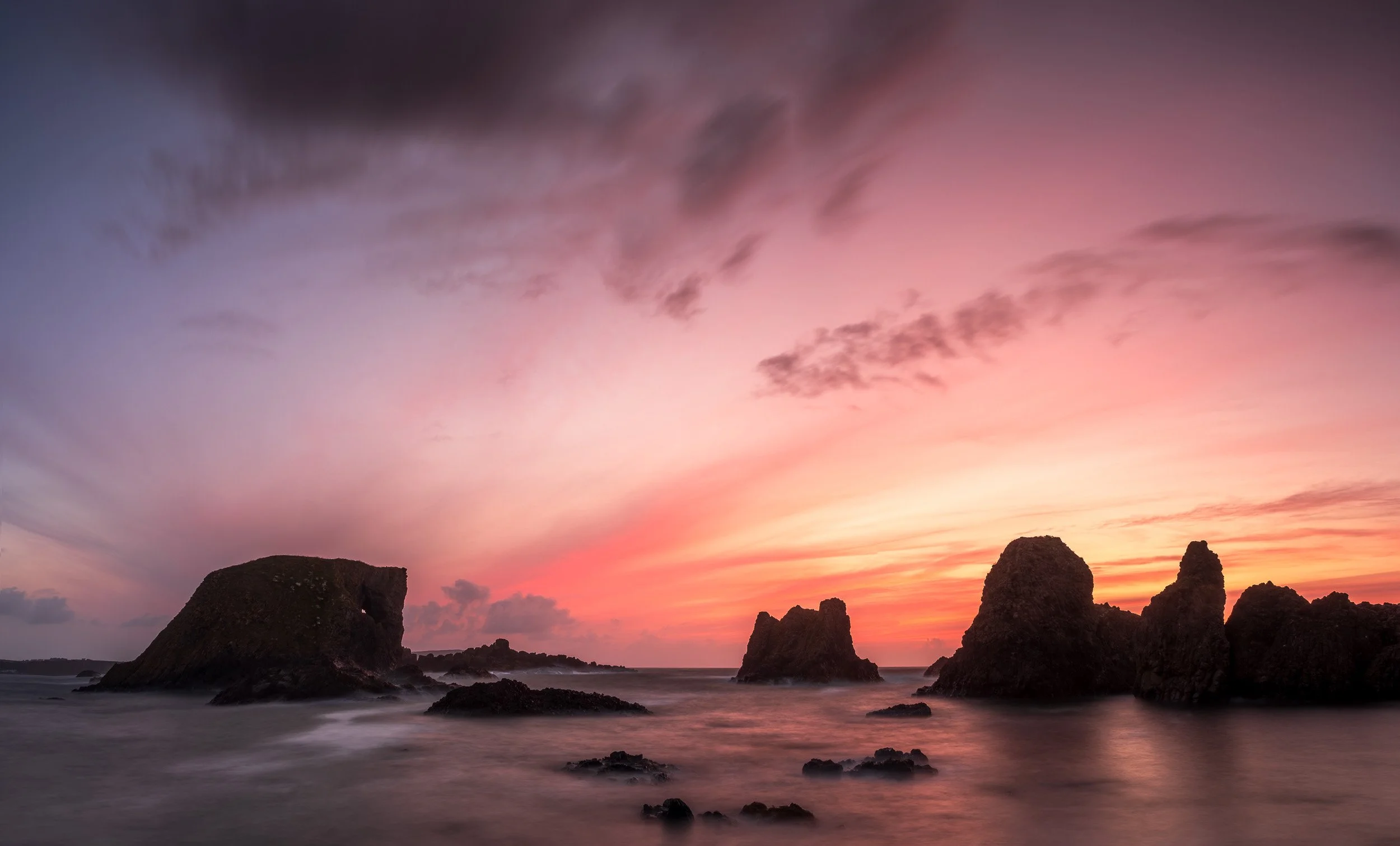
A long-exposure landscape photograph of Ballintoy Elephant on the Causeway Coast of Northern Ireland, photographed shortly after sunset. The incoming tide simplifies the foreground while the Elephant and surrounding sea stacks form dark silhouettes beneath a pale pink and orange sky.
Ballintoy Elephant is one of those locations I used to photograph regularly, but had largely neglected as drone photography became a bigger part of my landscape work. Early August gave me a good reason to return. The sun sets towards the Causeway headlands at this time of year, and with an incoming high tide I was hoping for strong evening light, cleaner compositions and enough movement in the water to make longer exposures worthwhile.
The walk from Ballintoy Harbour takes around 15 minutes, heading west along the coast and crossing several stiles. Most of the route is straightforward, although there are a few soft and muddy sections where water drains from the low slopes beside the path. The views towards the Elephant improve as you approach, and there are usually plenty of rabbits scattered through the surrounding grassland.
Working with the incoming tide
I had photographed Ballintoy Elephant many times before, so I already knew several compositions that worked. The main variable was the tide. At lower water there are numerous smaller rocks breaking the surface around the main formations, and although some can provide useful foreground interest, the scene can quickly become too complicated.
As the tide rises, many of these smaller rocks disappear and the composition becomes progressively simpler. That was one of the main reasons for choosing this particular evening, although the tide was running a little later than I would ideally have liked. Slow but persistent waves were moving into the sheltered bay, so I made occasional frames as both the water level and the light changed.
High water also reduces the number of viewpoints available. There was no particular danger from the tide in the sheltered bay, but it prevented me moving farther towards the Elephant to explore some of the closer positions I had used on previous visits.
For this photograph, I wanted to keep the opening which separates the Elephant's trunk from its body clearly visible. I also wanted the distinctive crown-shaped rock farther along the coast to sit close to the centre of the frame. Keeping the main formations relatively low allowed the sky to occupy more of the composition without the rocks competing too strongly with it.
I had hoped for stronger directional light across the rocks, which can work particularly well here during a midsummer sunset. That never really developed. Instead, after the sun had gone down, the sky took on much softer pale pink tones and the rocks became increasingly strong silhouettes.
It was the combination of that colour and the shapes of the rocks that eventually made this frame stand out when I reviewed the photographs later.
Making the photograph
I photographed the scene with a Fujifilm X-E5 and Fujifilm 16–50mm lens, using the lens at 16mm. The exposure was 3 seconds at f/11 and ISO 100, with a LEE polariser and LEE 1.2 soft-edge graduated ND filter. I also captured a bracket of three exposures to deal with the difference in brightness between the sky and foreground.
The three-second exposure was partly a consequence of the falling light, but it also suited the scene. I wanted to simplify the movement of the water around the rocks without turning the sea into a completely featureless surface. The incoming waves were slow and consistent enough to create some useful movement while retaining a little structure in the water.
Returning to the ground
One of the things the evening reminded me of was how differently I tend to work with a conventional camera compared with a drone. A drone gives much greater freedom to experiment with composition, allowing changes in height, distance and angle that simply aren't possible from the ground.
Working from a tripod is more restrictive in that sense, but it opens up other possibilities. Filters, long exposures and the changing movement of water become much more important, and there is more incentive to stay with a composition and watch how it develops rather than constantly looking for another viewpoint.
I didn't get the directional light I had originally gone to Ballintoy hoping for. The softer colour after sunset produced a different photograph, but one that worked particularly well with the strong shapes of the Elephant and the surrounding rocks.